Featured Viking river cruise itinerary
Viking Mississippi September 5-19 2026 Cruise & Offers | Viking Cruises
St Paul, Minnesota to New Orleans, Louisiana
Review this exact Viking sailing with Deluxe Cruises for accommodation guidance, current availability, eligible offers, and personal service before you reserve.
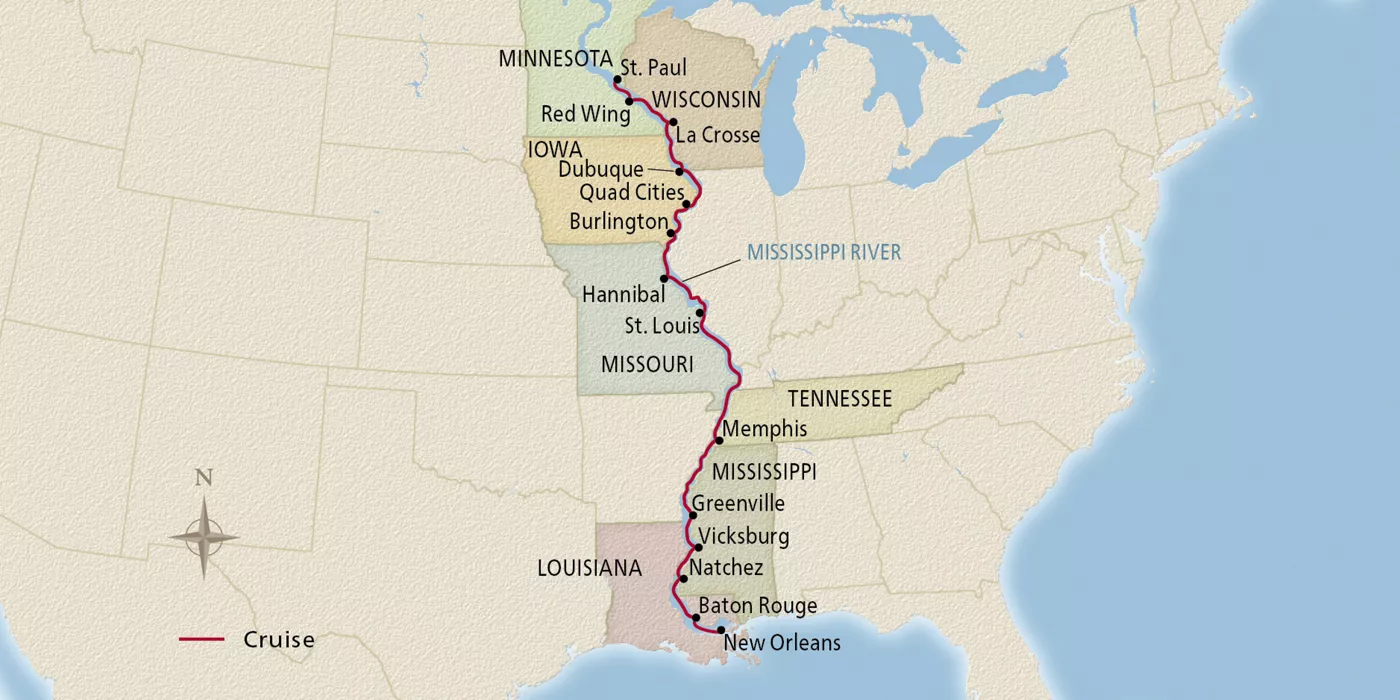
Itinerary at a Glance
September 5–19, 2026New Orleans grew around a crescent of the Mississippi, shaped by French, Spanish, African, Caribbean, and American influences. Creole architecture, jazz, neighborhood parades, streetcars, and distinctive food traditions animate the city. The French Quarter is only one part of a low-lying metropolis whose identity remains inseparable from water.
Baton Rouge, Louisiana’s capital, extends along a broad bend of the Mississippi River. The Gothic Revival Old State Capitol and towering modern capitol mark contrasting political eras. River commerce, university life, Creole and Cajun influences, and neighborhoods shaped by complex plantation and industrial histories give the city a character distinct from New Orleans.
Natchez occupies high bluffs above the Mississippi River near the southern end of the historic Natchez Trace. Its surviving antebellum houses reflect immense cotton wealth inseparable from enslaved labor. Indigenous Natchez history, African American heritage, river commerce, gardens, and a compact downtown provide a fuller account of this layered community.
Vicksburg occupies high bluffs above the Mississippi River, a position that made it strategically crucial during the American Civil War. The national military park preserves battlefield landscapes, monuments, and the restored ironclad USS Cairo. Downtown murals, museums, churches, and river overlooks interpret the city’s military, commercial, and cultural history.
Greenville is a Mississippi Delta city shaped by the river, cotton agriculture, levees, and a rich blues and literary heritage. The 1927 flood profoundly changed its communities and landscape. Museums, churches, older neighborhoods, and nearby wetlands provide context for a place where African American history and lower Mississippi culture remain especially significant.
Memphis faces the Mississippi from bluffs in southwest Tennessee. Beale Street, Sun Studio, and Stax traditions trace the development of blues, soul, rock and roll, and American popular music. The National Civil Rights Museum, located at the former Lorraine Motel, examines a defining and difficult chapter in the nation’s history.
Lower Mississippi is a named scenic passage, experienced from the vessel rather than as a visit ashore. The surrounding water, coast, islands, or riverbanks provide visual context as the route unfolds. Visibility, exact course, and timing can vary with weather, water levels, traffic, and operational conditions, so no fixed viewpoint or shore activity is implied.
St. Louis developed beside the Mississippi as a major gateway for trade and westward expansion. The Gateway Arch dominates the riverfront, while Forest Park contains museums, gardens, and broad green spaces. Brick neighborhoods, public markets, brewing history, blues traditions, and distinctive local food reveal a city far broader than its signature monument.
Hannibal occupies a bluff-lined stretch of the Mississippi River in northeastern Missouri. The preserved downtown, riverfront, and boyhood home of Samuel Clemens connect the city closely with Mark Twain’s writing. Limestone caves, nineteenth-century houses, and views from the surrounding hills evoke both the real river town and its enduring literary image.
Burlington, Iowa, climbs from the Mississippi River into wooded bluffs above a broad bend. Brick commercial blocks and Victorian houses recall its nineteenth-century importance in river and rail trade. Snake Alley, a remarkably winding brick street, is its best-known landmark, while the riverfront and surrounding farmland situate the city within southeast Iowa’s landscape.
The Quad Cities form a linked metropolitan area along the Mississippi River in Iowa and Illinois, centered on Davenport, Bettendorf, Rock Island, Moline, and East Moline. Riverfront trails, bridges, museums, historic neighborhoods, and industrial heritage connect the communities. The region’s identity reflects river commerce, manufacturing, and Midwestern cultural life.
Dubuque rises from the Mississippi River into steep bluffs at Iowa’s northeastern corner. Nineteenth-century warehouses and homes reflect lead mining, river commerce, and immigration. The National Mississippi River Museum, revitalized waterfront, and short Fenelon Place Elevator interpret local history, while wooded ridges provide broad views across the tri-state river landscape.
La Crosse occupies the Mississippi River where wooded bluffs rise above western Wisconsin. Riverside Park, historic commercial blocks, and preserved homes reflect its steamboat, logging, brewing, and rail eras. The surrounding coulees and overlooks reveal the Driftless Area, a landscape spared from the flattening effects of recent continental glaciers.
Red Wing is a Mississippi River town framed by wooded bluffs in southeastern Minnesota. Its brick downtown, nineteenth-century architecture, pottery heritage, and historic theater reflect a prosperous river and manufacturing past. Barn Bluff overlooks the city and broad river valley, while parks and trails connect the waterfront with the surrounding landscape.
St. Paul, Minnesota’s capital, rises in terraces above a bend in the Mississippi River. The domed State Capitol, Cathedral of Saint Paul, historic Summit Avenue, and cultural museums anchor its civic identity. River overlooks, parks, and brick commercial districts recall the city’s growth as a transportation and trading center.
A closer look at this sailing
America’s Great River aboard Viking Mississippi
On September 5–19, 2026, Viking Mississippi operates Viking voyage MSP260905 from St Paul, Minnesota to New Orleans, Louisiana. The published 15-day journey, America’s Great River, includes New Orleans, Louisiana, Baton Rouge, Louisiana, Natchez, Mississippi, Vicksburg, Mississippi, Greenville, Mississippi, Memphis, Tennessee, Scenic Sailing: Lower Mississippi, St. Louis, Missouri.
Port calls and their order reflect Viking's public itinerary at the time of collection. Public arrival and departure times were not supplied, so none have been invented here.
Personalized cruise planning with Viking
Ask Deluxe Cruises about Viking Mississippi Voyage MSP260905
Considering the September 5-19, 2026 Viking Mississippi sailing, Voyage MSP260905? A Deluxe Cruises specialist can verify this itinerary's current status and availability and assist with stateroom or suite selection and deck location, fare and inclusion comparisons, eligible offers, available amenities, and personalized planning.
We may have access to eligible pricing and amenities that are not displayed online. Before placing a deposit, ask us to compare a current like-for-like offer and review the value we can confirm for your requested sailing with Viking.
Comparable offers must be current and verifiable for the same ship or program, departure, accommodation category, fare terms, and inclusions. All fares, offers, and amenities are subject to eligibility, availability, and terms set by Viking.Ready to reserve Viking Mississippi?
Plan voyage MSP260905 with Deluxe Cruises
Contact us for personal suite or cabin advice and the best available eligible offer for this sailing.
Request Best Pricing