Featured Viking river cruise itinerary
Viking Ra April 7-25 2028 Cruise & Offers | Viking Cruises
Cairo to Cairo
Review this exact Viking sailing with Deluxe Cruises for accommodation guidance, current availability, eligible offers, and personal service before you reserve.
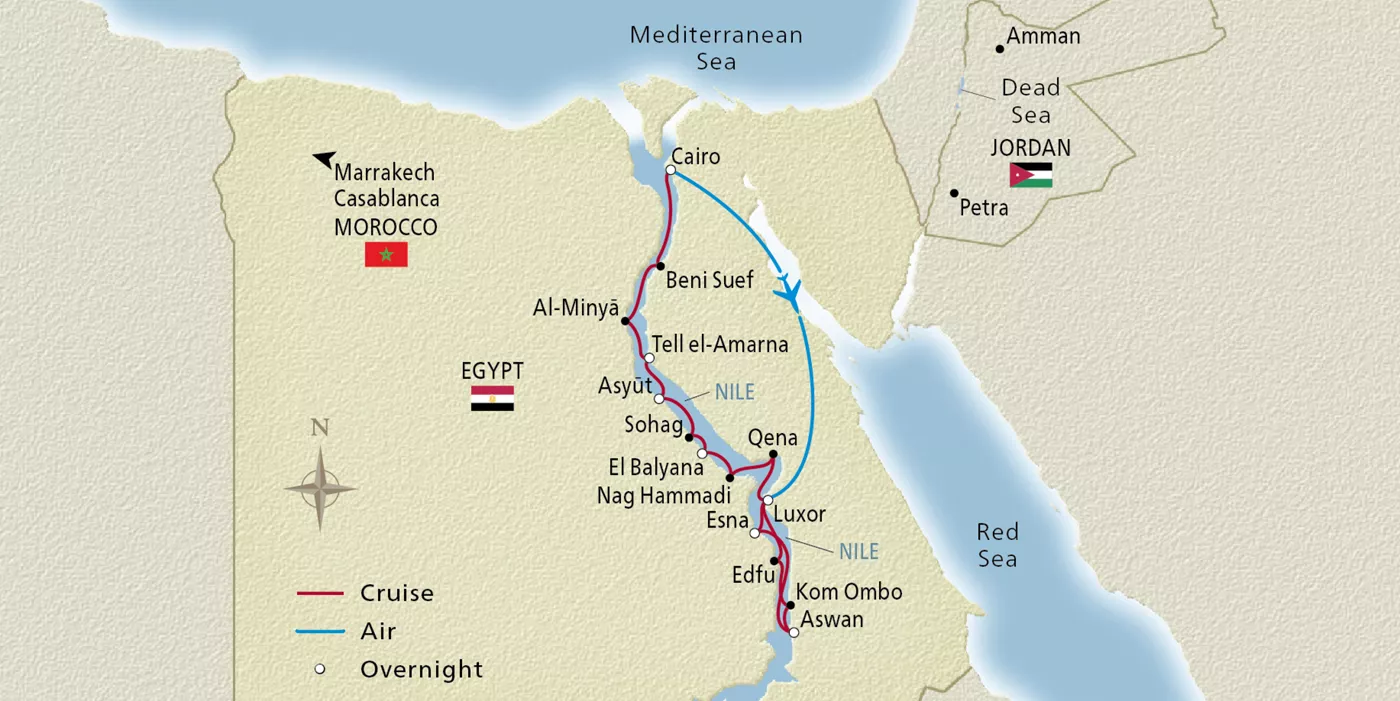
Itinerary at a Glance
April 7–25, 2028Cairo is a vast Nile metropolis where medieval lanes, nineteenth-century boulevards, and contemporary districts overlap. Islamic Cairo preserves celebrated mosques and gates, while Coptic Cairo reflects an older Christian heritage. Markets, museums, river islands, and the nearby Giza pyramids place daily urban life beside monuments spanning more than four thousand years of Egyptian history.
Cairo is a vast Nile metropolis where medieval lanes, nineteenth-century boulevards, and contemporary districts overlap. Islamic Cairo preserves celebrated mosques and gates, while Coptic Cairo reflects an older Christian heritage. Markets, museums, river islands, and the nearby Giza pyramids place daily urban life beside monuments spanning more than four thousand years of Egyptian history.
Cairo is a vast Nile metropolis where medieval lanes, nineteenth-century boulevards, and contemporary districts overlap. Islamic Cairo preserves celebrated mosques and gates, while Coptic Cairo reflects an older Christian heritage. Markets, museums, river islands, and the nearby Giza pyramids place daily urban life beside monuments spanning more than four thousand years of Egyptian history.
Luxor stands beside the Nile on the site of ancient Thebes, surrounded by an exceptional concentration of temples, tombs, and archaeological landscapes. Karnak and Luxor temples anchor the east bank, while the Valley of the Kings lies across the river. Heat, site distances, and opening hours should guide a measured day of exploration.
Luxor stands beside the Nile on the site of ancient Thebes, surrounded by an exceptional concentration of temples, tombs, and archaeological landscapes. Karnak and Luxor temples anchor the east bank, while the Valley of the Kings lies across the river. Heat, site distances, and opening hours should guide a measured day of exploration.
Scenic sailing on the Nile reveals the close relationship between cultivated riverbanks and the surrounding desert. Fields, settlements, and passing boats give context to Egypt’s ancient monuments and present-day life. This entry describes time aboard the ship, not a guaranteed shore visit; views and timing depend on the sailing conditions.
Esna is a Nile town where the Ptolemaic and Roman Temple of Khnum now stands below the level of surrounding streets. Its beautifully preserved columned hall contains intricate astronomical and ritual reliefs. A traditional market, river barrage, agricultural activity, and dense old lanes show everyday life continuing around a monument gradually revealed by excavation.
Aswan stretches along a particularly scenic reach of the Nile, where granite islands and desert hills frame the water. Nubian culture remains central to the city’s identity. Elephantine Island, the relocated temples of Philae, riverside markets, and traditional sailing craft illuminate ancient quarrying, regional trade, and daily life in southern Egypt.
Aswan stretches along a particularly scenic reach of the Nile, where granite islands and desert hills frame the water. Nubian culture remains central to the city’s identity. Elephantine Island, the relocated temples of Philae, riverside markets, and traditional sailing craft illuminate ancient quarrying, regional trade, and daily life in southern Egypt.
Kom Ombo lies within a cultivated stretch of the Nile Valley, with fields surrounding a town that includes a substantial Nubian community. Its temple rises above the river on a low hill. The setting brings together ancient monumental architecture, the agricultural landscape, and communities shaped by changes along the Nile.
Edfu is an agricultural Nile town dominated by the Temple of Horus, one of Egypt’s best-preserved ancient sanctuaries. Built during the Ptolemaic era, its monumental pylons, courts, inscriptions, and reliefs illustrate ritual life and royal symbolism. Beyond the enclosure, markets, fields, and busy streets show the modern community continuing around an extraordinary archaeological site.
Scenic sailing on the Nile reveals the close relationship between cultivated riverbanks and the surrounding desert. Fields, settlements, and passing boats give context to Egypt’s ancient monuments and present-day life. This entry describes time aboard the ship, not a guaranteed shore visit; views and timing depend on the sailing conditions.
Luxor stands beside the Nile on the site of ancient Thebes, surrounded by an exceptional concentration of temples, tombs, and archaeological landscapes. Karnak and Luxor temples anchor the east bank, while the Valley of the Kings lies across the river. Heat, site distances, and opening hours should guide a measured day of exploration.
Qena is an Upper Egyptian city on the Nile, surrounded by irrigated farmland and desert. It is the principal gateway to the remarkably preserved Temple of Hathor at nearby Dendera, whose decorated halls, crypts, and astronomical ceiling span several ancient periods. Qena itself remains a regional center for agriculture, crafts, and trade.
Nag Hammadi stands on the western bank of the Nile and is associated with the discovery of ancient Coptic manuscripts in 1945. These texts transformed research into early Christian and Gnostic thought. The riverside palace of Prince Youssef Kamal adds another historical layer, combining European and Islamic architectural influences.
El Balyana is an agricultural trading town in the fertile Nile Valley and a gateway to ancient Abydos. At the Temple of Seti I, finely worked reliefs and the celebrated royal list illuminate Egypt’s dynastic history. The surrounding landscape connects this important religious center with today’s farms and river communities.
Sohag brings together the living culture of the Nile Valley and a deep archaeological heritage. Its national museum introduces the region’s ancient past, while nearby monasteries reflect enduring Coptic traditions. Markets, residential streets, and the riverfront offer a contrasting view of contemporary Egyptian life beyond the major temple sites.
Asyūṭ is a historic Nile city whose strategic position linked different regions of Egypt. Known in antiquity as Lycopolis, it combines archaeological heritage with longstanding religious traditions. Nearby Deir el-Muharraq remains an important Coptic pilgrimage destination, associated by tradition with the Holy Family’s stay in Egypt.
Tell el-Amarna marks the desert site of Akhenaten’s short-lived royal capital, established during the fourteenth century BCE. Surviving foundations reveal the arrangement of palaces, temples, and residential districts. The archaeological landscape offers an unusual perspective on ancient urban life and the pharaoh’s dramatic religious reforms centered on the solar deity Aten.
Al-Minyā occupies the Nile’s western bank amid the landscapes of Middle Egypt. Across the river, the rock-cut tombs of Beni Hasan preserve paintings of farming, hunting, and skilled trades. The modern city’s markets, churches, and mosques provide a lively counterpart to these remarkable records of ancient everyday life.
Beni Suef is a working Nile city surrounded by the cultivated fields of Middle Egypt. Local markets reflect the region’s farming and craft traditions. Nearby Meidum preserves an early pyramid whose unusual surviving form reveals the experiments that helped Egyptian builders develop the smooth-sided monuments familiar today.
Cairo is a vast Nile metropolis where medieval lanes, nineteenth-century boulevards, and contemporary districts overlap. Islamic Cairo preserves celebrated mosques and gates, while Coptic Cairo reflects an older Christian heritage. Markets, museums, river islands, and the nearby Giza pyramids place daily urban life beside monuments spanning more than four thousand years of Egyptian history.
Cairo is a vast Nile metropolis where medieval lanes, nineteenth-century boulevards, and contemporary districts overlap. Islamic Cairo preserves celebrated mosques and gates, while Coptic Cairo reflects an older Christian heritage. Markets, museums, river islands, and the nearby Giza pyramids place daily urban life beside monuments spanning more than four thousand years of Egyptian history.
A closer look at this sailing
NEW! Grand Nile Journey II aboard Viking Ra
On April 7–25, 2028, Viking Ra operates Viking voyage VRA280410T from Cairo to Cairo. The published 19-day journey, NEW! Grand Nile Journey II, includes Cairo, Luxor, Scenic Sailing: Nile River, Esna, Aswan, Kom Ombo, Edfu, Qena. Deluxe Cruises can compare accommodation choices and current eligible offers for this exact departure.
Port calls and their order reflect Viking's public itinerary at the time of collection. Public arrival and departure times were not supplied, so none have been invented here.
Quick, low-cost quotes
Contact Deluxe Cruises before you reserve
Ask a Viking cruise specialist to compare the published route, accommodation options, availability, current offers, and eligible value for voyage VRA280410T.
Request Best Pricing
Receive personal guidance for this specific Viking Ra departure.
Ready to reserve Viking Ra?
Plan voyage VRA280410T with Deluxe Cruises
Contact us for personal suite or cabin advice and the best available eligible offer for this sailing.
Request Best Pricing