Featured Viking river cruise itinerary
Viking Rinda October 9-25 2026 Cruise & Offers | Viking Cruises
Bucharest to Vienna
Review this exact Viking sailing with Deluxe Cruises for accommodation guidance, current availability, eligible offers, and personal service before you reserve.
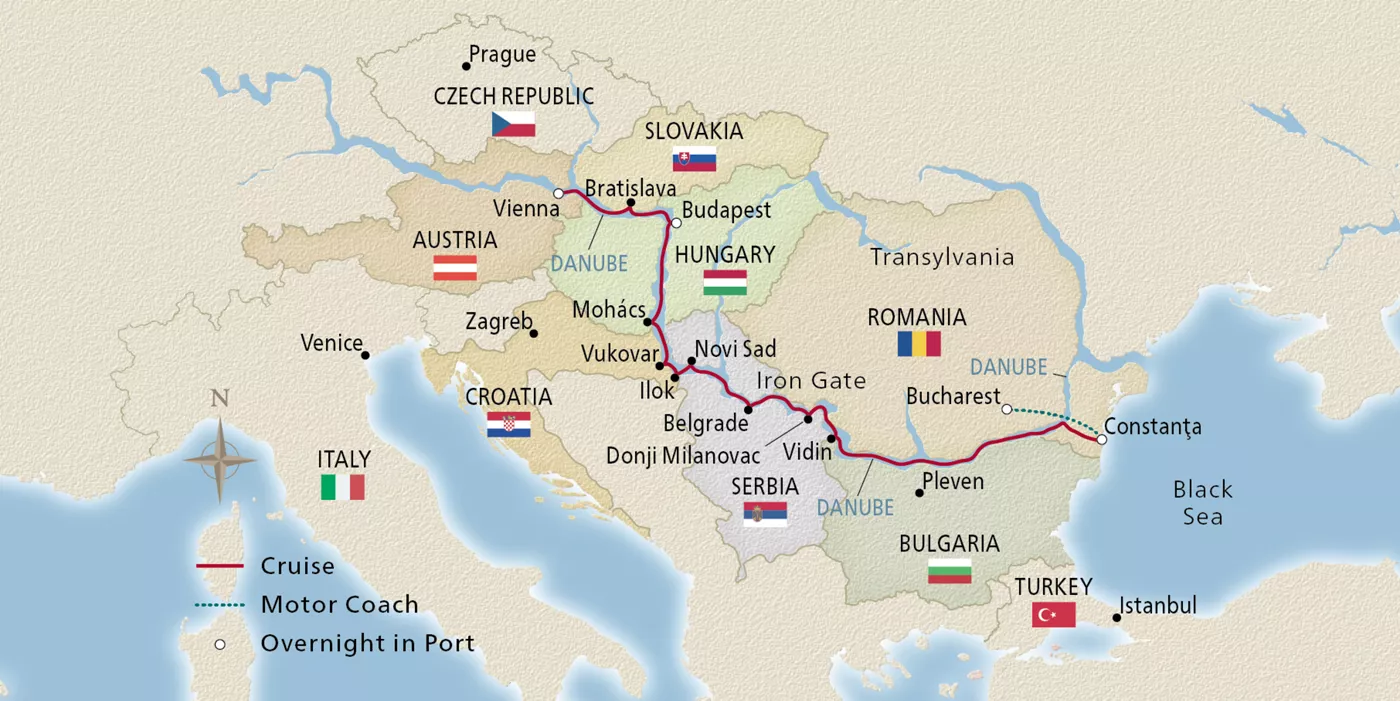
Itinerary at a Glance
October 9–25, 2026Bucharest is Romania’s expansive capital, known for broad boulevards, leafy parks, Orthodox churches, and architecture ranging from Belle Époque villas to monumental communist-era projects. The Romanian Athenaeum, Palace of Parliament, Village Museum, and animated Old Town reveal sharply contrasting periods. Its scale and layered streets reward attention beyond a single landmark.
Bucharest is Romania’s expansive capital, known for broad boulevards, leafy parks, Orthodox churches, and architecture ranging from Belle Époque villas to monumental communist-era projects. The Romanian Athenaeum, Palace of Parliament, Village Museum, and animated Old Town reveal sharply contrasting periods. Its scale and layered streets reward attention beyond a single landmark.
Bucharest is Romania’s expansive capital, known for broad boulevards, leafy parks, Orthodox churches, and architecture ranging from Belle Époque villas to monumental communist-era projects. The Romanian Athenaeum, Palace of Parliament, Village Museum, and animated Old Town reveal sharply contrasting periods. Its scale and layered streets reward attention beyond a single landmark.
Constanța is Romania’s principal Black Sea port, founded as ancient Tomis and later shaped by Greek, Roman, Ottoman, and modern influences. Ovid Square, archaeological collections, surviving Roman mosaics, Orthodox and Muslim landmarks, and the seafront casino reflect that layered past. Beaches and a vast commercial harbor frame the contemporary city.
Pleven is an inland city in northern Bulgaria closely associated with the decisive 1877 Siege of Plevna. The large Pleven Panorama, history museums, and memorial parks interpret that conflict, while the pedestrian center and Kaylaka Park show the modern city. The surrounding agricultural region also has a longstanding winemaking tradition.
Vidin is a Bulgarian city on the Danube near the borders with Romania and Serbia. The remarkably preserved Baba Vida fortress anchors its riverfront, while Ottoman-era structures, churches, a synagogue, and leafy parks reveal a multicultural past. The city’s quiet streets contrast with its former importance as a strategic frontier stronghold.
Donji Milanovac rests on the Danube within Serbia’s Iron Gates region, surrounded by the wooded slopes of Đerdap National Park. The modern town was relocated when the river was dammed. Nearby Lepenski Vir preserves an important Mesolithic settlement, while the broad waterway, gorge scenery, and fishing traditions define the community’s strong river connection.
Belgrade occupies a strategic ridge above the meeting of the Sava and Danube rivers. Kalemegdan Park and its fortress reveal layers of Roman, Ottoman, and Habsburg rule. The pedestrian Knez Mihailova district, Orthodox churches, modernist neighborhoods, and busy riverfronts express the resilient, energetic character of Serbia’s capital.
Novi Sad is a multicultural Serbian city on the Danube, facing the massive Petrovaradin Fortress. Its pedestrian center combines Austro-Hungarian façades, churches of several traditions, cafés, and cultural institutions reflecting Vojvodina’s diversity. Riverside parks and the fortress’s tunnels and viewpoints connect urban life with the city’s strategic past.
Vukovar stands where the Vuka River enters the Danube in eastern Croatia. Baroque buildings, the restored Eltz Manor museum, churches, and a broad riverside recall centuries of frontier history. Memorials and damaged structures confront the devastating 1991 siege, making modern remembrance an essential part of understanding this rebuilt city.
Mohács is a Danube town in southern Hungary remembered for the pivotal battles of 1526 and 1687. Its best-known living tradition is Busójárás, a UNESCO-recognized winter festival featuring carved masks, sheepskin costumes, music, and bonfires. Riverside memorials and a multicultural regional heritage add context beyond the annual celebration.
Budapest is defined by the Danube, which separates hilly Buda from the flatter avenues of Pest. Castle Hill, the Parliament, Chain Bridge, market halls, and grand cafés frame the river’s urban panorama. Historic thermal baths and architecture mixing Gothic Revival, Art Nouveau, and Ottoman influences reveal the many cultures that shaped Hungary’s capital.
Budapest is defined by the Danube, which separates hilly Buda from the flatter avenues of Pest. Castle Hill, the Parliament, Chain Bridge, market halls, and grand cafés frame the river’s urban panorama. Historic thermal baths and architecture mixing Gothic Revival, Art Nouveau, and Ottoman influences reveal the many cultures that shaped Hungary’s capital.
Bratislava, Slovakia’s capital, sits on the Danube beneath a prominent white castle. Its compact old town contains baroque palaces, medieval gates, narrow lanes, and St. Martin’s Cathedral, once used for Hungarian coronations. Modern riverside development and nearby Little Carpathian vineyards complement a city shaped by Slovak, Hungarian, Austrian, and Jewish histories.
Vienna combines Habsburg palaces, grand Ringstrasse institutions, baroque churches, and intimate neighborhoods along the Danube. The Hofburg, Schönbrunn Palace, major art museums, concert halls, markets, and coffeehouses express different aspects of the Austrian capital. Formal architecture coexists with vineyards, parks, and a living tradition of music and design.
Vienna combines Habsburg palaces, grand Ringstrasse institutions, baroque churches, and intimate neighborhoods along the Danube. The Hofburg, Schönbrunn Palace, major art museums, concert halls, markets, and coffeehouses express different aspects of the Austrian capital. Formal architecture coexists with vineyards, parks, and a living tradition of music and design.
Vienna combines Habsburg palaces, grand Ringstrasse institutions, baroque churches, and intimate neighborhoods along the Danube. The Hofburg, Schönbrunn Palace, major art museums, concert halls, markets, and coffeehouses express different aspects of the Austrian capital. Formal architecture coexists with vineyards, parks, and a living tradition of music and design.
A closer look at this sailing
Capitals of Eastern Europe aboard Viking Rinda
On October 9–25, 2026, Viking Rinda operates Viking voyage RND261011T from Bucharest to Vienna. The published 17-day journey, Capitals of Eastern Europe, includes Bucharest, Constanța, Pleven, Vidin, Donji Milanovac, Belgrade, Novi Sad, Vukovar.
Port calls and their order reflect Viking's public itinerary at the time of collection. Public arrival and departure times were not supplied, so none have been invented here.
Personalized cruise planning with Viking
Ask Deluxe Cruises about Viking Rinda Voyage RND261011T
Considering the October 9-25, 2026 Viking Rinda sailing, Voyage RND261011T? A Deluxe Cruises specialist can verify this itinerary's current status and availability and assist with stateroom or suite selection and deck location, fare and inclusion comparisons, eligible offers, available amenities, and personalized planning.
We may have access to eligible pricing and amenities that are not displayed online. Before placing a deposit, ask us to compare a current like-for-like offer and review the value we can confirm for your requested sailing with Viking.
Comparable offers must be current and verifiable for the same ship or program, departure, accommodation category, fare terms, and inclusions. All fares, offers, and amenities are subject to eligibility, availability, and terms set by Viking.Ready to reserve Viking Rinda?
Plan voyage RND261011T with Deluxe Cruises
Contact us for personal suite or cabin advice and the best available eligible offer for this sailing.
Request Best Pricing