Featured Viking river cruise itinerary
Viking Vidar October 21-November 12 2026 Cruise & Offers | Viking Cruises
Amsterdam to Bucharest
Review this exact Viking sailing with Deluxe Cruises for accommodation guidance, current availability, eligible offers, and personal service before you reserve.
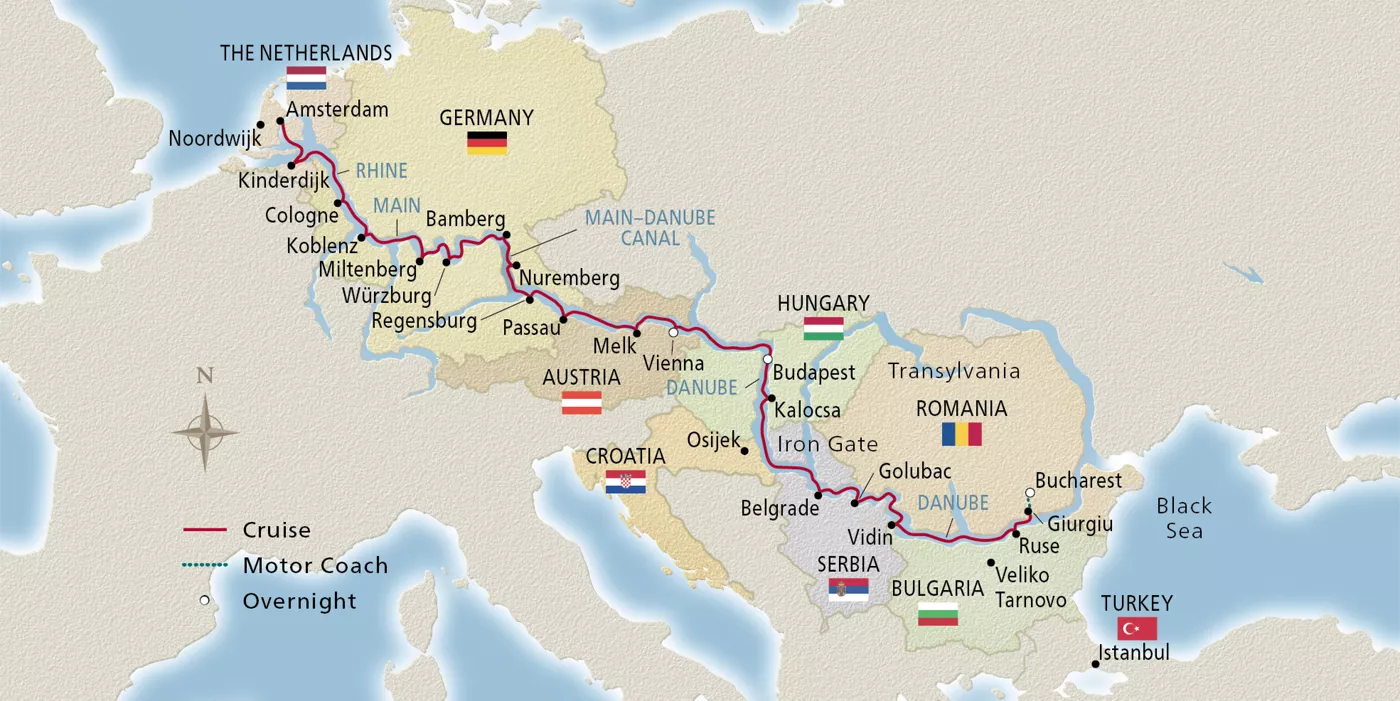
Itinerary at a Glance
October 21–November 12, 2026Amsterdam’s concentric canals frame gabled houses, intimate bridges and neighborhoods shaped by centuries of commerce. Major art museums, historic interiors, markets and café-lined streets offer many ways to explore. Its compact core is especially walkable, while canal perspectives reveal how water, architecture and daily life remain closely connected.
Kinderdijk’s nineteen historic windmills stand among canals and low polders near the meeting of the Lek and Noord rivers. Built largely in the eighteenth century, the UNESCO-listed system demonstrates how Dutch communities drained and managed flood-prone land. Footpaths, waterways, and pumping installations reveal centuries of practical water engineering.
Cologne spans the Rhine around its immense twin-spired cathedral, a Gothic landmark completed across more than six centuries. Roman remains, medieval churches, museums, and reconstructed old-town lanes reveal the city’s long history. Contemporary art, Carnival traditions, Kölsch beer halls, and a busy riverside reflect the confident culture of Germany’s largest Rhine city.
Koblenz stands where the Moselle meets the Rhine at the triangular Deutsches Eck. Above the rivers, Ehrenbreitstein Fortress commands wide views of the confluence and surrounding hills. Roman foundations, medieval churches, wine taverns, and a restored old town reflect the city’s strategic importance across two millennia.
Main River, Spessart is a named scenic passage, experienced from the vessel rather than as a visit ashore. The surrounding water, coast, islands, or riverbanks provide visual context as the route unfolds. Visibility, exact course, and timing can vary with weather, water levels, traffic, and operational conditions, so no fixed viewpoint or shore activity is implied.
Würzburg is a Franconian city on the Main surrounded by vineyard-covered hills. The baroque Würzburg Residence, renowned for its grand staircase and Tiepolo fresco, contrasts with the medieval Marienberg Fortress across the river. The Old Main Bridge, churches, wine taverns, and rebuilt center express the city’s artistic and viticultural heritage.
Bamberg spreads across seven hills and islands in the Regnitz River, preserving one of Germany’s finest medieval townscapes. Its cathedral, Old Court, baroque residences, and bridge-mounted Old Town Hall reflect centuries of ecclesiastical power. Half-timbered lanes, riverside houses, market gardens, and distinctive smoked beer sustain a strong local identity.
Nuremberg’s walled old town, imperial castle, churches, and craftsmen’s houses reflect its importance in the Holy Roman Empire. The city also confronts its twentieth-century role through the former Nazi Party Rally Grounds and trials documentation. Albrecht Dürer’s legacy and the renowned Christmas market add further historical and cultural layers.
Regensburg preserves one of Germany’s most complete medieval centers beside the Danube. The stone bridge, Gothic cathedral, patrician towers, narrow lanes, and remains of the Roman Castra Regina reveal successive eras of trade and imperial influence. Traditional taverns and riverside squares add everyday character within the UNESCO-listed old town.
Passau occupies a narrow peninsula where the Danube, Inn, and Ilz rivers meet. Its pastel old town and baroque St. Stephen’s Cathedral reflect rebuilding after seventeenth-century fires, while Veste Oberhaus surveys the confluence from above. The rivers’ contrasting colors and surrounding wooded hills define the Bavarian border city’s setting.
Melk is a small Danube town dominated by its immense golden Baroque abbey. The Benedictine complex contains an ornate church, grand library, imperial rooms, and terraces overlooking the Wachau Valley. Below, quiet streets and old houses provide a human-scale contrast to the monastery and the wooded hills surrounding the river.
Vienna combines Habsburg palaces, grand Ringstrasse institutions, baroque churches, and intimate neighborhoods along the Danube. The Hofburg, Schönbrunn Palace, major art museums, concert halls, markets, and coffeehouses express different aspects of the Austrian capital. Formal architecture coexists with vineyards, parks, and a living tradition of music and design.
Vienna combines Habsburg palaces, grand Ringstrasse institutions, baroque churches, and intimate neighborhoods along the Danube. The Hofburg, Schönbrunn Palace, major art museums, concert halls, markets, and coffeehouses express different aspects of the Austrian capital. Formal architecture coexists with vineyards, parks, and a living tradition of music and design.
Budapest is defined by the Danube, which separates hilly Buda from the flatter avenues of Pest. Castle Hill, the Parliament, Chain Bridge, market halls, and grand cafés frame the river’s urban panorama. Historic thermal baths and architecture mixing Gothic Revival, Art Nouveau, and Ottoman influences reveal the many cultures that shaped Hungary’s capital.
Budapest is defined by the Danube, which separates hilly Buda from the flatter avenues of Pest. Castle Hill, the Parliament, Chain Bridge, market halls, and grand cafés frame the river’s urban panorama. Historic thermal baths and architecture mixing Gothic Revival, Art Nouveau, and Ottoman influences reveal the many cultures that shaped Hungary’s capital.
Kalocsa is a historic Hungarian town near the Danube, long associated with an archbishopric and its prominent cathedral. The surrounding Great Plain is known for paprika cultivation, vividly embroidered folk dress, and painted floral motifs. Museums and traditional houses help explain a regional culture distinct from Hungary’s larger urban centers.
Osijek stretches along the Drava River in Croatia’s eastern Slavonia region. The baroque Tvrđa fortress district preserves cobbled streets, bastions, and Habsburg-era buildings, while a long riverside promenade links parks and neighborhoods. Secessionist architecture, markets, and regional cuisine reflect the city’s Central European and Balkan cultural crossroads.
Belgrade occupies a strategic ridge above the meeting of the Sava and Danube rivers. Kalemegdan Park and its fortress reveal layers of Roman, Ottoman, and Habsburg rule. The pedestrian Knez Mihailova district, Orthodox churches, modernist neighborhoods, and busy riverfronts express the resilient, energetic character of Serbia’s capital.
Golubac stands on the Danube in eastern Serbia at the entrance to the Iron Gates gorge. Its restored medieval fortress extends from the riverbank up a rocky slope, with towers controlling the historic passage. The adjacent village, broad reservoir, wooded hills, and nearby Đerdap National Park place the stronghold within a dramatic frontier landscape.
Vidin is a Bulgarian city on the Danube near the borders with Romania and Serbia. The remarkably preserved Baba Vida fortress anchors its riverfront, while Ottoman-era structures, churches, a synagogue, and leafy parks reveal a multicultural past. The city’s quiet streets contrast with its former importance as a strategic frontier stronghold.
Ruse faces Romania across the Danube in northern Bulgaria. Prosperity from nineteenth-century river trade gave its center ornate neo-Baroque and neo-Rococo façades, broad squares, and the nickname Little Vienna. Roman remains, Orthodox churches, museums, and a long riverside park add older and contemporary layers to this important border city.
Bucharest is Romania’s expansive capital, known for broad boulevards, leafy parks, Orthodox churches, and architecture ranging from Belle Époque villas to monumental communist-era projects. The Romanian Athenaeum, Palace of Parliament, Village Museum, and animated Old Town reveal sharply contrasting periods. Its scale and layered streets reward attention beyond a single landmark.
Bucharest is Romania’s expansive capital, known for broad boulevards, leafy parks, Orthodox churches, and architecture ranging from Belle Époque villas to monumental communist-era projects. The Romanian Athenaeum, Palace of Parliament, Village Museum, and animated Old Town reveal sharply contrasting periods. Its scale and layered streets reward attention beyond a single landmark.
A closer look at this sailing
European Sojourn aboard Viking Vidar
On October 21–November 12, 2026, Viking Vidar operates Viking voyage VDR261021A from Amsterdam to Bucharest. The published 23-day journey, European Sojourn, includes Amsterdam, Kinderdijk, Cologne, Koblenz, Scenic Sailing: Main River, Spessart, Würzburg, Bamberg, Nuremberg.
Port calls and their order reflect Viking's public itinerary at the time of collection. Public arrival and departure times were not supplied, so none have been invented here.
Personalized cruise planning with Viking
Ask Deluxe Cruises about Viking Vidar Voyage VDR261021A
Considering the October 21-November 12, 2026 Viking Vidar sailing, Voyage VDR261021A? A Deluxe Cruises specialist can verify this itinerary's current status and availability and assist with stateroom or suite selection and deck location, fare and inclusion comparisons, eligible offers, available amenities, and personalized planning.
We may have access to eligible pricing and amenities that are not displayed online. Before placing a deposit, ask us to compare a current like-for-like offer and review the value we can confirm for your requested sailing with Viking.
Comparable offers must be current and verifiable for the same ship or program, departure, accommodation category, fare terms, and inclusions. All fares, offers, and amenities are subject to eligibility, availability, and terms set by Viking.Ready to reserve Viking Vidar?
Plan voyage VDR261021A with Deluxe Cruises
Contact us for personal suite or cabin advice and the best available eligible offer for this sailing.
Request Best Pricing