Featured Viking river cruise itinerary
Viking Vili May 21-June 11 2027 Cruise & Offers | Viking Cruises
Budapest to Bergen
Review this exact Viking sailing with Deluxe Cruises for accommodation guidance, current availability, eligible offers, and personal service before you reserve.
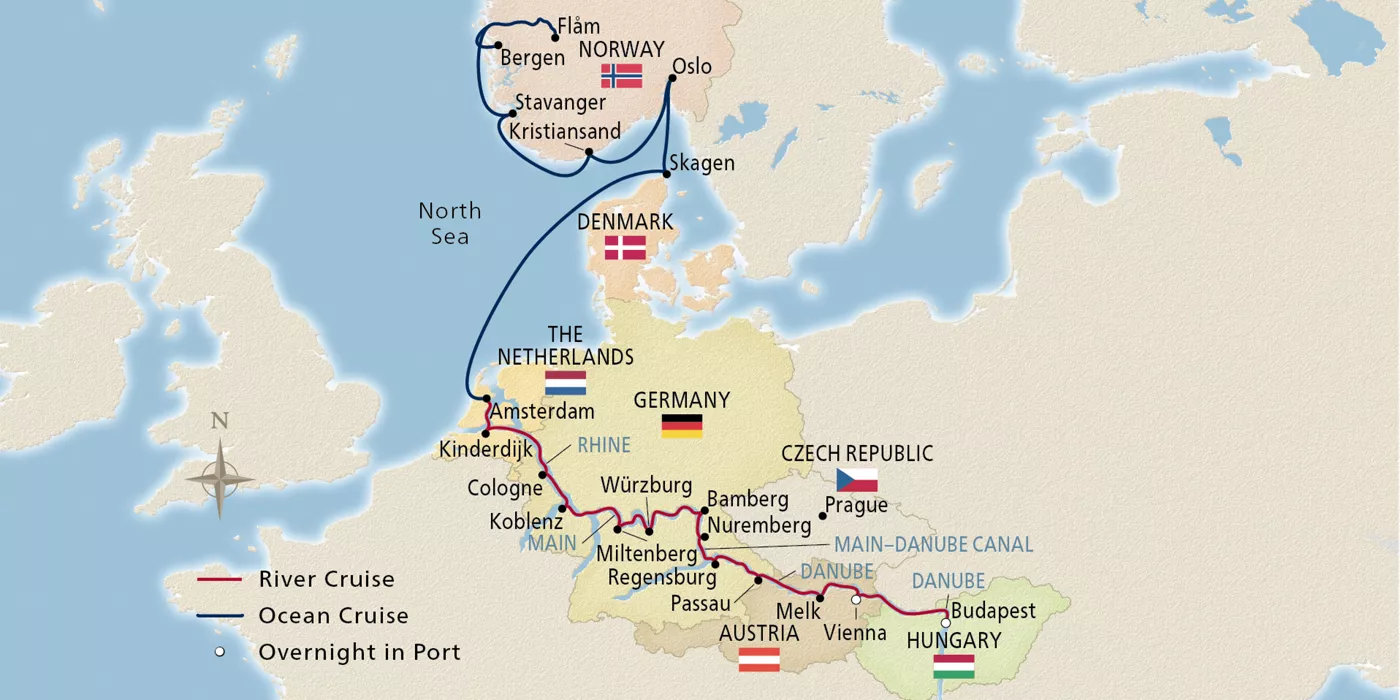
Itinerary at a Glance
May 21–June 11, 2027Budapest is defined by the Danube, which separates hilly Buda from the flatter avenues of Pest. Castle Hill, the Parliament, Chain Bridge, market halls, and grand cafés frame the river’s urban panorama. Historic thermal baths and architecture mixing Gothic Revival, Art Nouveau, and Ottoman influences reveal the many cultures that shaped Hungary’s capital.
Budapest is defined by the Danube, which separates hilly Buda from the flatter avenues of Pest. Castle Hill, the Parliament, Chain Bridge, market halls, and grand cafés frame the river’s urban panorama. Historic thermal baths and architecture mixing Gothic Revival, Art Nouveau, and Ottoman influences reveal the many cultures that shaped Hungary’s capital.
Vienna combines Habsburg palaces, grand Ringstrasse institutions, baroque churches, and intimate neighborhoods along the Danube. The Hofburg, Schönbrunn Palace, major art museums, concert halls, markets, and coffeehouses express different aspects of the Austrian capital. Formal architecture coexists with vineyards, parks, and a living tradition of music and design.
Vienna combines Habsburg palaces, grand Ringstrasse institutions, baroque churches, and intimate neighborhoods along the Danube. The Hofburg, Schönbrunn Palace, major art museums, concert halls, markets, and coffeehouses express different aspects of the Austrian capital. Formal architecture coexists with vineyards, parks, and a living tradition of music and design.
Melk is a small Danube town dominated by its immense golden Baroque abbey. The Benedictine complex contains an ornate church, grand library, imperial rooms, and terraces overlooking the Wachau Valley. Below, quiet streets and old houses provide a human-scale contrast to the monastery and the wooded hills surrounding the river.
Passau occupies a narrow peninsula where the Danube, Inn, and Ilz rivers meet. Its pastel old town and baroque St. Stephen’s Cathedral reflect rebuilding after seventeenth-century fires, while Veste Oberhaus surveys the confluence from above. The rivers’ contrasting colors and surrounding wooded hills define the Bavarian border city’s setting.
Regensburg preserves one of Germany’s most complete medieval centers beside the Danube. The stone bridge, Gothic cathedral, patrician towers, narrow lanes, and remains of the Roman Castra Regina reveal successive eras of trade and imperial influence. Traditional taverns and riverside squares add everyday character within the UNESCO-listed old town.
Nuremberg’s walled old town, imperial castle, churches, and craftsmen’s houses reflect its importance in the Holy Roman Empire. The city also confronts its twentieth-century role through the former Nazi Party Rally Grounds and trials documentation. Albrecht Dürer’s legacy and the renowned Christmas market add further historical and cultural layers.
Bamberg spreads across seven hills and islands in the Regnitz River, preserving one of Germany’s finest medieval townscapes. Its cathedral, Old Court, baroque residences, and bridge-mounted Old Town Hall reflect centuries of ecclesiastical power. Half-timbered lanes, riverside houses, market gardens, and distinctive smoked beer sustain a strong local identity.
Würzburg is a Franconian city on the Main surrounded by vineyard-covered hills. The baroque Würzburg Residence, renowned for its grand staircase and Tiepolo fresco, contrasts with the medieval Marienberg Fortress across the river. The Old Main Bridge, churches, wine taverns, and rebuilt center express the city’s artistic and viticultural heritage.
Main River, Spessart is a named scenic passage, experienced from the vessel rather than as a visit ashore. The surrounding water, coast, islands, or riverbanks provide visual context as the route unfolds. Visibility, exact course, and timing can vary with weather, water levels, traffic, and operational conditions, so no fixed viewpoint or shore activity is implied.
Koblenz stands where the Moselle meets the Rhine at the triangular Deutsches Eck. Above the rivers, Ehrenbreitstein Fortress commands wide views of the confluence and surrounding hills. Roman foundations, medieval churches, wine taverns, and a restored old town reflect the city’s strategic importance across two millennia.
Cologne spans the Rhine around its immense twin-spired cathedral, a Gothic landmark completed across more than six centuries. Roman remains, medieval churches, museums, and reconstructed old-town lanes reveal the city’s long history. Contemporary art, Carnival traditions, Kölsch beer halls, and a busy riverside reflect the confident culture of Germany’s largest Rhine city.
Waal & Merwede is a named scenic passage, experienced from the vessel rather than as a visit ashore. The surrounding water, coast, islands, or riverbanks provide visual context as the route unfolds. Visibility, exact course, and timing can vary with weather, water levels, traffic, and operational conditions, so no fixed viewpoint or shore activity is implied.
Amsterdam’s concentric canals frame gabled houses, intimate bridges and neighborhoods shaped by centuries of commerce. Major art museums, historic interiors, markets and café-lined streets offer many ways to explore. Its compact core is especially walkable, while canal perspectives reveal how water, architecture and daily life remain closely connected.
The passage across the North Sea is an at-sea period connecting destinations along the route. The day centers on navigation and views from the vessel rather than a scheduled shore visit. Weather, sea conditions, traffic, and operational needs can influence the exact course and visibility, so no particular coastal view, sighting, or activity is guaranteed.
Skagen occupies Denmark’s sandy northern tip, where distinctive coastal light attracted a celebrated colony of nineteenth-century painters. Yellow houses, studios and the Skagens Museum preserve their legacy. At Grenen, currents from the Skagerrak and Kattegat meet beyond a shifting spit, while dunes and the sand-buried church reveal a wind-shaped landscape.
Oslo sits at the head of a long fjord, combining forested surroundings with bold contemporary architecture and wide waterfront spaces. The Opera House, MUNCH museum and National Museum anchor a strong cultural scene, while Bygdøy’s museums explore Norway’s maritime past. Parks, cafés and easy access to nature give the capital an unusually relaxed rhythm.
Kristiansand is a bright southern Norwegian city laid out around a lively harbor and the orderly streets of Posebyen, its historic wooden quarter. Waterfront promenades connect cultural venues, parks and a former fortress, while nearby islands and skerries evoke the region’s summer character. Local seafood and relaxed cafés complement an easy day ashore.
Stavanger combines a prosperous modern waterfront with Gamle Stavanger’s preserved white wooden houses and cobbled lanes. Museums explore Norway’s maritime, canning and energy industries, while restaurants showcase the fertile surrounding region. The port is also a gateway to Lysefjord, where sheer cliffs and high plateaus create some of southwestern Norway’s defining scenery.
Flåm sits at the head of Aurlandsfjord, surrounded by precipitous mountains, waterfalls, and a narrow farmed valley. The Flåm Railway climbs dramatically toward the high plateau through tunnels and tight curves, revealing the engineering required by the terrain. A small waterfront, nearby farms, and fjord scenery define this compact western Norwegian settlement.
Bergen spreads between seven mountains and a busy harbor, serving as a historic gateway to Norway’s fjord country. The colorful wooden warehouses of Bryggen recall centuries of Hanseatic trade, while the fish market and hillside neighborhoods reward leisurely exploration. A funicular ascent offers broad views across the city, islands and surrounding waterways.
A closer look at this sailing
Grand European & Viking Fjords aboard Viking Vili
On May 21–June 11, 2027, Viking Vili operates Viking voyage VIL270521X from Budapest to Bergen. The published 22-day journey, Grand European & Viking Fjords, includes Budapest, Vienna, Melk, Passau, Regensburg, Nuremberg, Bamberg, Würzburg. Deluxe Cruises can compare accommodation choices and current eligible offers for this exact departure.
Port calls and their order reflect Viking's public itinerary at the time of collection. Public arrival and departure times were not supplied, so none have been invented here.
Quick, low-cost quotes
Contact Deluxe Cruises before you reserve
Ask a Viking cruise specialist to compare the published route, accommodation options, availability, current offers, and eligible value for voyage VIL270521X.
Request Best Pricing
Receive personal guidance for this specific Viking Vili departure.
Ready to reserve Viking Vili?
Plan voyage VIL270521X with Deluxe Cruises
Contact us for personal suite or cabin advice and the best available eligible offer for this sailing.
Request Best Pricing